


Description
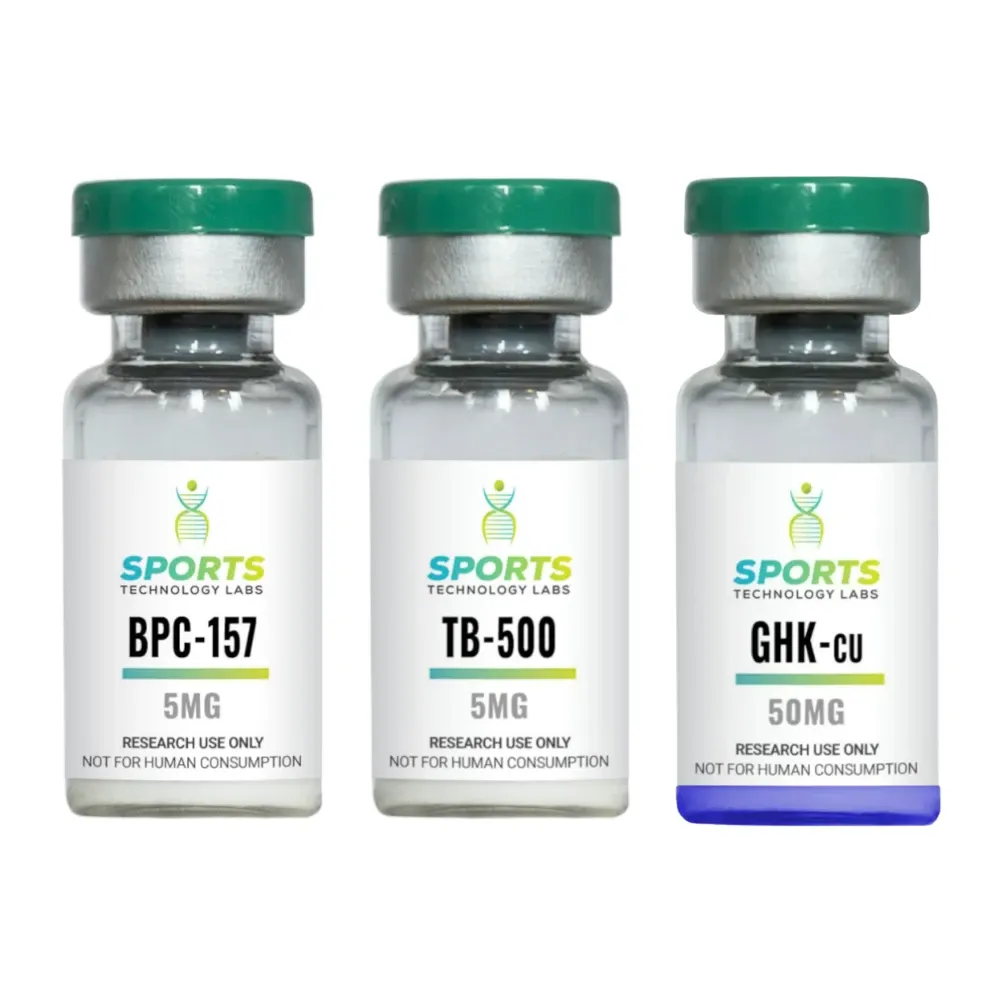
The Glow peptide stack from Sports Technology Labs is three separate vials in one order: BPC-157 5mg, TB-500 5mg and GHK-Cu 50mg. Each vial is freeze-dried and sealed on its own. It’s intended for lab and analytical work only.
The compounds in the Glow peptide stack
BPC-157 is a 15-amino-acid peptide based on a fragment of body protection compound, a protein first found in gastric juice. It’s one of the most widely studied research peptides, almost entirely in rodents.
TB-500: Thymosin beta-4 is a 43-amino-acid protein found in nearly every cell, where it binds actin and helps control cell movement. TB-500 is the name used for synthetic thymosin beta-4 and for a short fragment of its active region.
GHK-Cu is the tripeptide glycyl-L-histidyl-L-lysine bound to a copper(II) ion. Loren Pickart first isolated GHK from human plasma in 1973, and levels in plasma are reported to fall with age.
Why researchers order the Glow peptide stack
Glow adds the copper peptide GHK-Cu, tied to collagen and tissue remodeling, to the BPC-157 and TB-500 repair pair. That covers blood vessel growth, cell migration and matrix rebuilding in one order, which is why it turns up mostly in skin and wound models.
Separate containers mean separate control. Nothing is premixed, so each compound can be measured on its own schedule.
How the Glow peptide stack works
Nobody has pinned down a single receptor for BPC-157. Lab studies point to several pathways: it raises VEGF receptor expression, which feeds blood vessel growth, it interacts with the nitric oxide system, and it increases growth hormone receptor levels in tendon cells.
Thymosin beta-4’s main job is holding on to G-actin, the building block of the cell’s internal scaffolding. By controlling how much actin is free to polymerize, it controls how cells move and change shape.
GHK binds copper tightly and can deliver it to cells. Copper is a cofactor for lysyl oxidase, the enzyme that cross-links collagen and elastin, and for antioxidant enzymes.
Glow peptide stack specifications
- BPC-157, 5mg vial, 99.85% by HPLC (CAS 137525-51-0, C62H98N16O22, 1,419.5 g/mol)
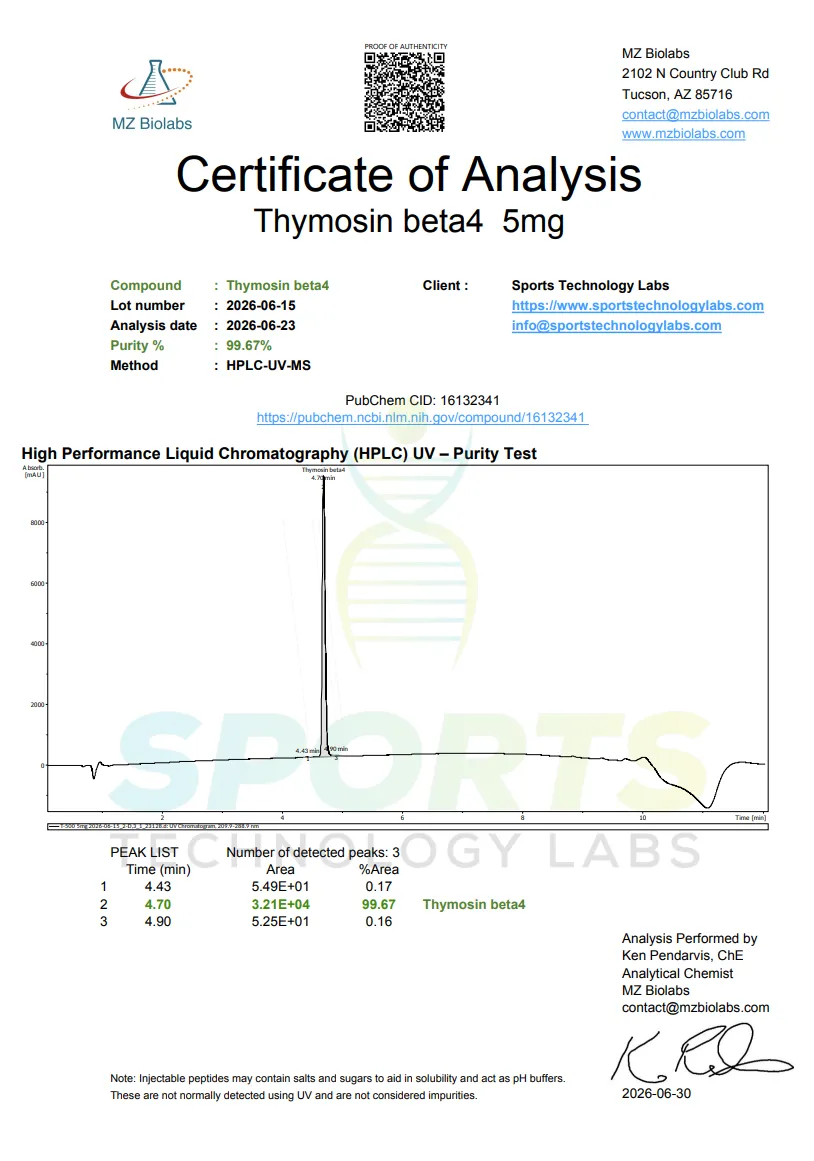
- TB-500 (synthetic thymosin beta-4), 5mg vial, 99.42% by HPLC (CAS 77591-33-4, C212H350N56O78S, 4,963.4 g/mol)
- GHK-Cu, 50mg vial, 99.97% by HPLC (CAS 49557-75-7)
- Form: lyophilized powder in sterile glass vials
- Tested by: MZ Biolabs, Tucson, Arizona
- SKU: STL-GLOW
- Intended use: laboratory research only
Research behind the Glow peptide stack
Most of the work comes from Predrag Sikiric’s group at the University of Zagreb. Their rodent studies report faster healing of tendon, ligament, muscle and gut injuries, and Mikus and colleagues described improved burn wound healing in mice.
Goldstein and colleagues reviewed thymosin beta-4’s role in wound repair in 2012, covering faster closure of skin wounds and new blood vessel growth in animal models.
Maquart and colleagues reported in 1988 that GHK-Cu stimulated collagen synthesis in cultured fibroblasts, and later rat wound-chamber studies found more collagen and glycosaminoglycan buildup.
All of these studies are indexed on PubMed. This combined search pulls them up.
Glow peptide stack purity and lab testing
Every batch is sent to MZ Biolabs in Tucson, Arizona, before it goes on sale. They run HPLC for purity and mass spectrometry to confirm identity. The latest certificates for this product read BPC-157 at 99.85%, TB-500 at 99.42% and GHK-Cu at 99.97%.
You’ll find the COA in the photo gallery above. Open it and check the date, the method and the purity figure yourself.
HPLC and mass spec answer different questions. HPLC tells you what share of the sample is the main compound. Mass spec tells you the compound is the right molecule. A COA with only one of them leaves a gap.
You also get a 60-day money-back guarantee on the order.
Preparing and storing the Glow peptide stack
Diluent isn’t included; most labs use bacteriostatic water. Reconstitute each vial separately: let it reach room temperature, add the diluent slowly down the glass and swirl until clear. Divide the milligrams in the vial by the millilitres added to get the concentration.
- BPC-157 5mg with 2mL added gives 2.5mg per mL
- TB-500 5mg with 2mL added gives 2.5mg per mL
- GHK-Cu 50mg with 2mL added gives 25mg per mL
Keep sealed vials in the fridge at 2 to 8°C. Mixed vials stay refrigerated too and are best used within 30 days. Don’t freeze them.
Related to Glow peptide stack
- GHK-Cu Copper Peptide 50mg, a copper peptide
- Melanotan II 10mg, a melanocortin agonist
- KPV Peptide 5mg, an alpha-MSH tripeptide
- BPC-157 5mg, a 15-amino-acid peptide
- PEG-MGF 2mg, a pegylated MGF
Want the whole catalog? Open our skin and tanning peptides and healing and recovery peptides, or start from the Sports Technology Labs home page.
Glow peptide stack FAQ
What’s in the Glow peptide stack?
BPC-157 5mg, TB-500 5mg and GHK-Cu 50mg, as three separate vials.
Is there a discount on the Glow peptide stack?
Yes. Pay with crypto at checkout and you get 15% off your order.
Where is the Glow peptide stack lab report?
In the product gallery. MZ Biolabs tested the batch and the posted purity is BPC-157 at 99.85%, TB-500 at 99.42% and GHK-Cu at 99.97%.
Can I buy the Glow peptide stack compounds separately?
Yes: BPC-157, TB-500 and GHK-Cu.
How should the Glow peptide stack be stored?
In the fridge at 2 to 8°C, before and after mixing.
Get this stack from Sports Technology Labs
Order this stack now for $184.99. It’s in stock, it ships free and crypto payments get 15% off at checkout.
More options for this research area are in our skin and tanning peptides and healing and recovery peptides.
Sports Technology Labs sells this product for laboratory and in-vitro research only. It isn’t a medicine, food or dietary supplement, and it must not be given to people or animals. The FDA has not evaluated any statement on this page. Buyers must be 21 or older.


Reviews
There are no reviews yet.